
Here’s the bottom-line advice from the Center for Food as Medicine and Longevity. To be extra safe:
- NEVER drink any water onboard that isn’t in a sealed bottle.
- Do not drink coffee or tea onboard.
- Do not wash your hands in the bathroom; use alcohol-based hand sanitizer containing at least 60% alcohol instead.
A 2026 Airline Water Study released last week by the Center for Food as Medicine & Longevity reveals that the quality of drinking water varies significantly by airline, and many airlines continue to provide passengers with potentially unhealthy water.
Unhealthy water violates the federal government’s Aircraft Drinking Water Rule (ADWR), which was implemented in 2011 and requires airlines to provide passengers and flight crew with safe drinking water.
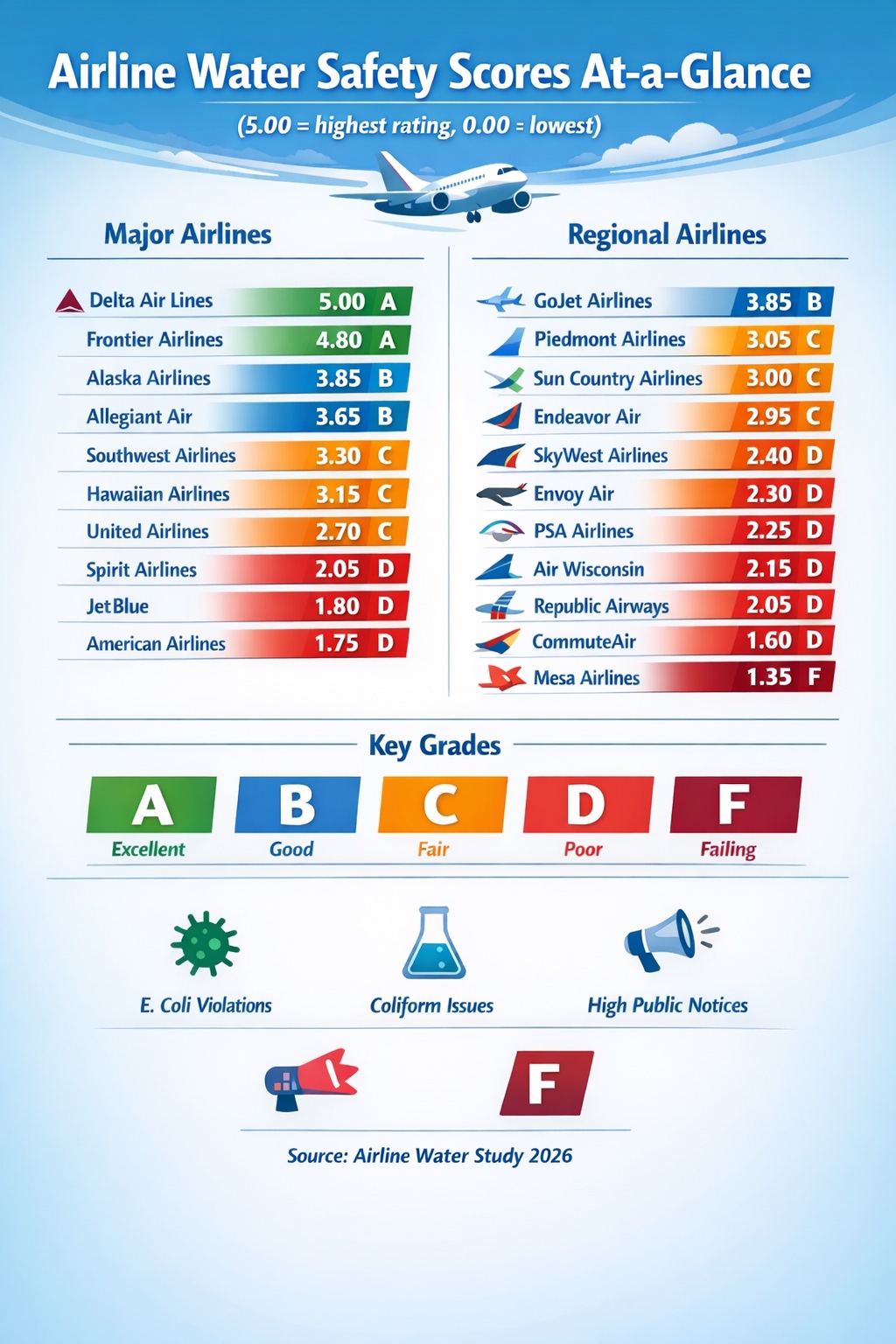
The 2026 Airline Water Study ranks 10 major and 11 regional airlines by the quality of water they provided onboard flights during a three-year study period (October 1, 2022 through September 30, 2025). Each airline was given a “Water Safety Score” (5.00 = highest rating, 0.00 = lowest) based on five weighted criteria, including violations per aircraft, Maximum Contaminant Level violations for E. coli, indicator-positive rates, public notices, and disinfecting and flushing frequency. A score of 3.5 or better indicates that the airline has relatively safe, clean water and earns a Grade A or B.
“Delta Air Lines and Frontier Airlines win the top spots with the safest water in the sky, and Alaska Airlines finishes No. 3,” says Charles Platkin, PhD, JD, MPH, director of the Center for Food as Medicine and Longevity.
The airlines with the worst score are American Airlines and JetBlue, the study shows. “Nearly all regional airlines need to improve their onboard water safety, with the exception of GoJet Airlines,” Platkin says.
The ADWR requires airlines to take samples from their water tanks to test for coliform bacteria and possible E. coli. Airlines are also required to disinfect and flush each aircraft’s water tank four times per year. Alternatively, an airline may choose to disinfect and flush once a year, but then it must test monthly.
The 2026 Airline Water Study also finds that the Environmental Protection Agency – one of the federal agencies responsible for ensuring safe aircraft drinking water – rarely levies civil penalties to airlines in violation of the ADWR.
Here are the study’s findings:
- The major airlines receiving the highest Water Safety Scores are Delta Air Lines (5.00, Grade A) and Frontier Airlines (4.80, Grade A). Alaska Airlines is a close third at 3.85 (Grade B).
- GoJet Airlines is the highest-rated regional carrier with a score of 3.85 (Grade B).
- Among major airlines, American Airlines has the lowest score of 1.75 (Grade D).
- Nearly all regional airlines have poor Water Safety Scores. Mesa Airlines has the lowest score among rated regional carriers at 1.35 (Grade F), and CommuteAir is second-lowest at 1.60 (Grade D). CommuteAir shows an alarming 33.33% total coliform positive rate.
- The study window analyzed 35,674 total sample locations tested for total coliform bacteria across all airlines. Of these, 949 locations (2.66%) tested positive for total coliform.
- Maximum Contaminant Level violations for E. coli were identified as the strongest downward driver of airline scores. There were 32 such violations across the 21-airline universe during the study window.
- The “Shame on You” Award goes to the EPA for weak enforcement. The study shows that civil penalties for ADWR violations remain extremely rare.
- Testing for coliform bacteria is important, because their presence in drinking water indicates that disease-causing organisms (pathogens) could be in the water system.
- When an aircraft’s water sample tests positive for coliform, it must be tested again to determine if E. coli is present. If E. coli is not present, the airline must take repeat samples within 24 hours, disinfect and flush the water system within 72 hours, or shut down the water system within 72 hours and then disinfect and flush. If the sample is E. coli positive, the airline must shut off public access to the water system within 24 hours and disinfect and flush.
- The ADWR does not require the same testing as the National Primary Drinking Water Regulations, which includes other microorganisms in addition to total coliform.
- An aircraft flies to numerous destinations and may pump drinking water into its tanks from various sources at domestic and international locations. The water quality onboard also depends on the safety of the equipment used to transfer the water, such as water cabinets, trucks, carts and hoses.
